
Nobody’s Perfect
The rarest thing in baseball wasn’t the perfect game


Nobody’s perfect.
Except in baseball. There, perfection for a pitcher has a clear definition. Twenty-seven batters. Twenty-seven outs. No hits. No walks. No errors. No one reaches base.
No mistakes.
In the history of Major League Baseball, almost a quarter of a million games have been played. Only twenty-four have been perfect.
It is one of the rarest accomplishments in sports. The kind of thing that can define a career. Pitchers come and go. Win some games, lose some games, get traded, get hurt, fade from memory. But throw a perfect game and you are forever a part of baseball history.
No one can take it away.
Or so we thought.
Wednesday, June 2, 2010. Detroit, Michigan.
An early summer evening baseball game between the Tigers and the Indians.
It had everything to love about baseball. The fresh cut of the grass, manicured infield. A beautiful evening. Clear skies, and a warm summer breeze blowing out to left field. Flags waving. People taking their seats. America’s pastime.
Armando Galarraga was pitching for the Tigers. A journeyman who the previous year had bounced back and forth between the minor and major league. He was doing his best to hold onto the spot as the Tigers’ fifth starter. Out of five.
It was a midweek game between two middle-of-the-pack clubs. Seventeen thousand fans in attendance. About half the stadium's capacity.
Galarraga started strong. First inning. Three up, three down.
In the second inning, Tigers first baseman and future hall of famer Miguel Cabrera hit a home run to give the Tigers a 1-0 lead.
Galarraga kept dealing. He had a great sinker that night. Inning and after inning he got batters out. All of them. The Tigers defense did their part.
But by about the fifth inning people started to realize something special on the line.
Something perfect.
Baseball is a superstitious sport. One of its oldest unwritten rules is that you can’t mention a perfect game while it is in progress. You will jinx it. It got to the point that no one on the Tigers would talk to Galarraga between innings. Or even sit anywhere near him on the bench. Or even make eye contact with him.
Around the 6th inning, Cleveland’s shortstop Jason Donald did the math on the number of outs left and his place in the lineup. He realized that if the perfect game held he would be the 27th batter. The last man standing between Galarraga and perfection.
7th inning. Three Cleveland batters up. Three down. Same in the top of the 8th.
In the bottom of the 8th inning, the Tigers added two runs to give themselves a 3-0 lead.
Galarraga and the Tigers were perfect through 8 innings.
It was all down to the 9th inning.
But baseball history is littered with near misses. More perfect games have been broken up in the 9th inning than there have been actual perfect games.
This game had moved so quickly that the sun had still not set on a long summer evening.
It was a perfect setting for a perfect game.
Every fan in the stadium was on their feet.
The first hitter up, Mark Grudzielanek, drove a deep fly ball to left-center field. For four and a half seconds, the entire baseball universe held its breath to see if it would drop for a hit or clear the fence for a home run.
The ball traveled almost 400 feet and would have been a home run in most major league parks. But Comerica Park was different.
Center fielder Austin Jackson, one of the fastest players in the league, broke at the crack of the bat and sprinted nearly 100 feet toward the wall.
Unbelievably, he made a spectacular Willie Mays-type over-the-shoulder catch just before crashing into the center field fence.
It is one of the greatest catches you will ever see.
Out one.
It felt like the baseball Gods had officially blessed Galarraga.
Next batter hit a routine ground ball to the shortstop. Out two.
Then as predicted a few innings earlier, Jason Donald came to the plate.
One batter left. One out from perfection.
Donald hit a weak ground ball. The first baseman fielded it cleanly and tossed it to Galarraga covering the bag.
Galarraga beat the runner there.
He caught the ball.
His foot hit first base.
Donald was a step away.
Third out.
A perfect game.
The crowd erupted.
Tigers players celebrated.
History had been made.
But wait...
Jim Joyce, the first base umpire, spread his arms wide.
Safe.
There was stunned silence in a crowd that seemed to have swollen far beyond its announced attendance.
And across the country and all the way to Venezuela, where Galarraga grew up dreaming of moments like this, the baseball world was stunned.
It took a few seconds for everyone to understand what had happened.
Jim Joyce was not some random umpire. He was a veteran with a 30-year career. One of the most respected umpires in the game. He worked World Series games, playoff games, and All-Star Games.
If you wanted a call made right, Jim Joyce was the man you wanted making it.
But nobody’s perfect.
Donald admitted he was out. Cleveland’s first base coach admitted he was out. The replay left no room for debate.
The Tigers manager came out to argue. But this was before the era of instant replay.
It was done.
Jason Donald was safe.
The perfect game was gone.
One man had been wronged.
Another man had failed.
The crowd booed unmercifully. Stunned silence turned to disbelief and then quickly to anger. It was tense.
Galarraga composed himself and faced the next batter.
Ground ball. Easy catch. Easy throw. Out.
The game was now over.
No perfect game. Not even a no-hitter.
Tigers players angrily confronted Joyce as he tried to make his way off the field.
But not Galarraga. He waved to the crowd, entered the dugout, and headed into the clubhouse.
Joyce was escorted off the field and into the umpires’ room beneath the stadium.
He asked third-base umpire and crew chief Derryl Cousins if he had gotten the call right.
“No Jimmy,” Cousins replied. “I don’t think you did.”
Then Joyce saw the replay.
Donald was out.
The call was wrong.
He knew it immediately.
And he broke down in tears.
At that point, he could have left the stadium and gone home.
No one would have blamed him.
But he did something rare for a major league umpire.
He faced the media.
All of them. At once.
And he admitted he got it wrong.
“I took a perfect game away from that kid who worked his ass off all night.”
He could have hidden behind, “I call ‘em like I see ‘em,” or simply avoided the media altogether.
But he didn’t.
The whole world was attacking him. His entire career suddenly felt reduced to one mistake.
And he leaned in.
He shared that before his media appearance he asked the Tigers if he could talk to Galarraga. Galarraga agreed and Joyce said, “I went right to him and told him, ‘I made a mistake. I’m really sorry.’ He gave me a hug, and I can’t tell you how much respect I have for that kid.”
The 28 year old journeyman with a chance at baseball immortality hugged the man who had taken it away.
Galarraga for his part said to the media, “He feels more bad than I do. I mean, nobody’s perfect.”
One man chose grace.
The other chose accountability.
The reaction of Galarraga did not match the reaction of the rest of the world. Major League Baseball assigned security to Joyce and his family after death threats started pouring in.
The next day was the series finale. A Thursday afternoon game between the same two teams. Less than sixteen hours after the blown call.
Joyce was scheduled to work home plate.
MLB tried to take him off the crew for a few days.
He refused.
He was going back out there.
He was going to face the fans.
He was going to own his mistake.
As the umpires emerged from the tunnel, a chorus of vicious boos rained down on Joyce.
Before every major league game, the managers bring their lineup cards to home plate. They meet the umpires, shake hands, review the ground rules, and then it is time to play ball.
But on this afternoon, it wasn’t Tigers manager Jim Leyland who emerged from the dugout carrying the lineup card.
It was Armando Galarraga.
The crowd heard the announcement and the boos transformed into cheers for the hero of the game the night before.
Galarraga strode to home plate and shook Jim Joyce’s hand.
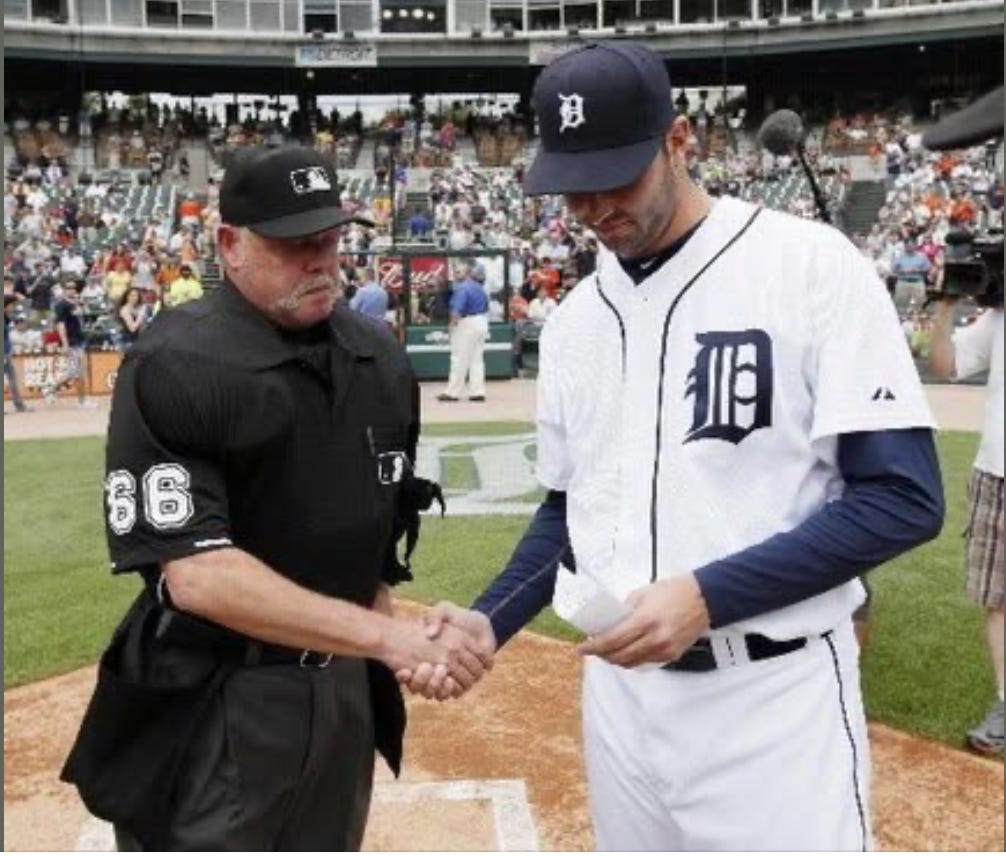
Galarraga did not give a speech. He did not ask the crowd to forgive. He simply walked to home plate and showed them how.
In a moment, he gave the crowd permission to do what he had already done.
He didn’t teach the baseball world a lesson.
He taught all of us one.
Life eventually puts us in both positions; sometimes we are Galarraga, and sometimes we are Joyce.
When we are Galarraga, something important is taken from us. We are treated unfairly and forced to pay the price for a mistake that wasn’t ours. We lose a job, a reputation, an opportunity, or a version of the future we thought we had earned.
But when we are Joyce, we are the ones who get it wrong. We fail, we hurt someone, and we make a mistake that cannot be fully repaired. We live with the agonizing wish that we could go back and make the call differently, terrified of being defined by a single, catastrophic moment.
Sometimes, life is complicated enough that we experience both things at the same time.
The question is not whether those moments will come. They will.
The question is who we become when they do.
One man could have become bitter, but chose grace.
The other could have become defensive, but chose accountability.
This grueling emotional roller coaster forged an unlikely bond between two completely different men. They became friends.
A gruff veteran umpire from Ohio and a young pitcher from Venezuela.
Different generations. Different backgrounds. Different lives.
Linked forever by one moment neither of them would have ever chosen.
Maybe some people eventually forgive. Maybe some move on.
Very few truly embrace one another.
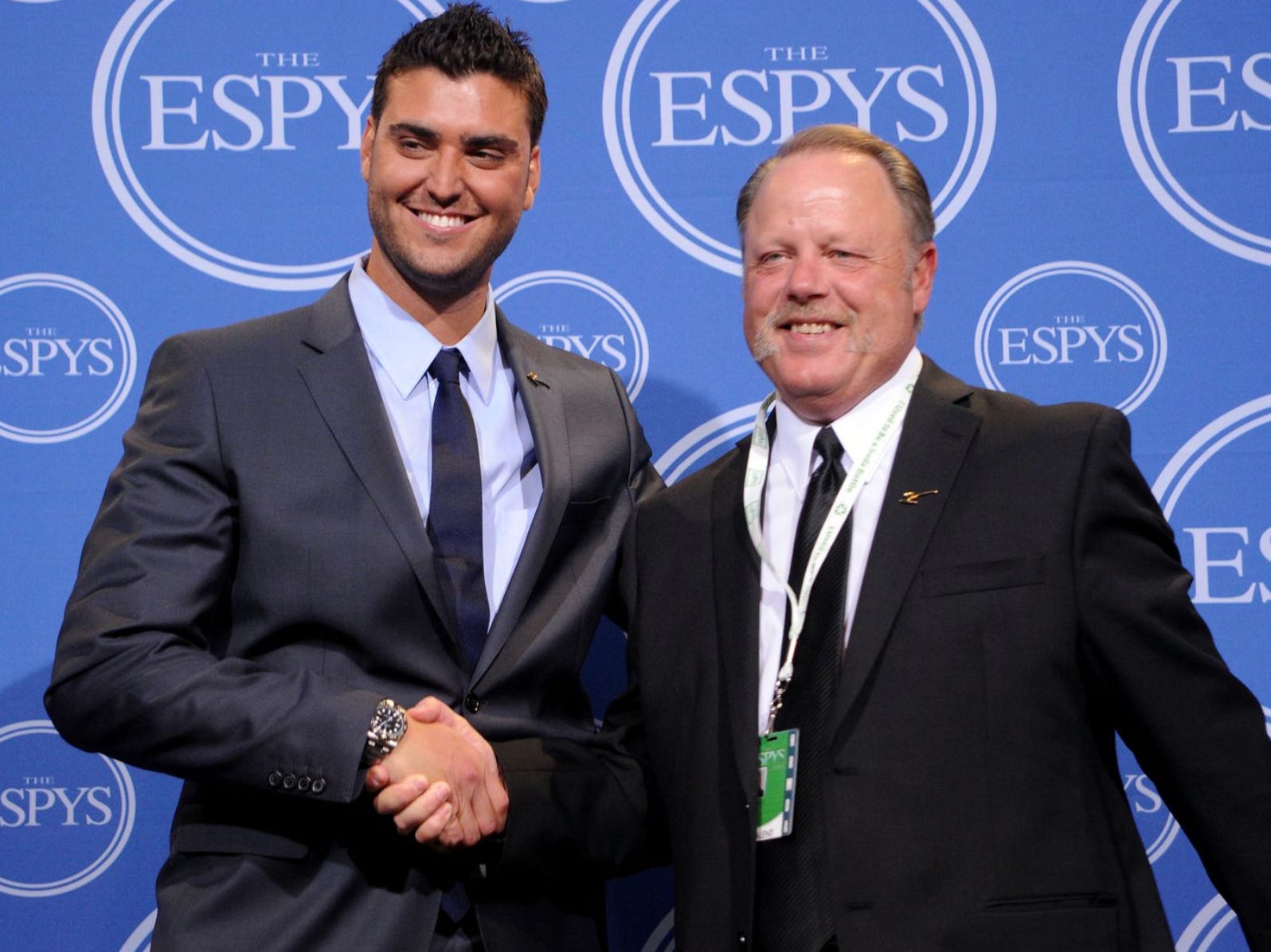
Almost none write a book together.
Yet that's exactly what they did. Their book is appropriately titled, “Nobody’s Perfect”.
They turned a moment that could have produced a lifetime of bitterness into something that produced understanding and love.
That may be the most remarkable part of this story.
A perfect game happens once every ten thousand baseball games.
Accountability and grace can seem even more rare.
Armando Galarraga never got credit for a perfect game.
Jim Joyce never got to take back the call.
But a life doesn’t have to be defined by one moment.
Two years later, Joyce would save the life of an Arizona Diamondbacks employee by administering CPR during a cardiac emergency at Chase Field.
Today, Armando Galarraga teaches youth baseball. I suspect he teaches them about a lot more than just baseball.
People are more than their worst day.
They are also more than their best one.
“I don’t want to make it sappy and say it was love,” Joyce said. “But the support I got was just..love.”
Who says there is no crying in baseball?
If you enjoyed this piece, consider subscribing for free to receive future essays.
Everything here is available to everyone at no cost. If the writing has been meaningful to you and you’d like to support the work, there is also an optional paid subscription.
If you know someone who might enjoy this piece, please consider sharing it:
Damn, you got me again. Great writing as always. This is something I need to work on deeply.
keep it up my friend!
Wow! All I can say is Wow!! This is what grace, gratitude and joy looks like! And the beautiful part? These kinds of moments are available to ALL of us!!
Nathan, you are an amazing writer, not only because you can wordsmith (because you can!), but because what pours out onto the page comes from your lived experience and your heart and touches me to my soul!! I can cry at the drop of a pin. This one had rivers coming down my face. Thank you!!! 🥲